Calmel & Joseph - Créateurs de grands vins en Languedoc-Roussillon Calmel & Joseph - Créateurs de grands vins en Languedoc-Roussillon
Menu

  • OUR WORLD
  • The domaine
  • Our values 
  • The Vineyards
  • Wines
    • The Domaine
    • Our creations
    • Villa Blanche
    • Amstramgram
  • News
  • WINE TOURISM
  • The cottages
    • Les Terroirs, 5 ppl
    • Les Crus, 9 ppl
    • Les Cuvées Rares, 6 ppl
    • Le Domaine, 10 ppl
  • The wine cellars
  • Activities
  • Weddings and events
  • Seminars
  • THE E-SHOP
  • Our wines
  • Our appellations
  • Other products
  • Promotions
  • The Tribe
  • CONTACT
  • Coordinates
  • Contact area
  • Social networks
    • FB
    • IN
    • LK
  • OUR UNIVERSE
    • The domaine
    • Our values
    • The Vineyards
    • Wines
    • News
  • WINE TOURISME
    • The cottages
    • The wine cellars
    • Activities
    • Weddings and events
    • Seminars
  • THE E-SHOP
    • Our wines
    • Our appellations
    • Other products
    • Promotions
    • The Tribe
  • CONTACT
    • Coordinates
    • Contact area
    • FB
    • IN
    • LK
  • fr
  • en

THE ORIGINS OF THE DOMAINE

A traditional Languedoc farmstead, shaped by history

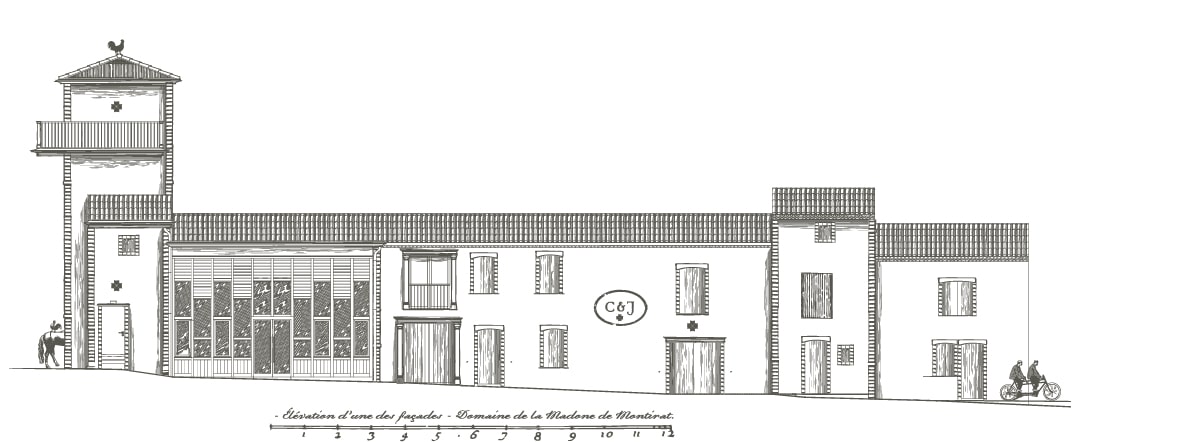
Domaine Calmel & Joseph is a former Languedoc farmstead with a long history (Roman ruins remain hidden to this day within its rocky scrubland).

It first appears in a deed of ownership in the name of Noble Jehan de Calmès – Lord of Saint Jullia on July 26th 1577. Over the course of its history, it has had several names, including Borde Neuve and La Madone. In 1590, the village of Montirat was looted, burned and completely destroyed. Borde Nove was most certainly heavily damaged, with agricultural activity only resuming in 1595 after peace was restored.

It was a typical farm of the period, spanning around 15 hectares, where cereals were grown – mainly wheat, but also oats, barley, rye and lentils. Olives were grown, and livestock was farmed for wool production. Vines were farmed on the estate for family needs, starting in the 16th century.

« DOMAINE CALMEL & JOSEPH »

A privileged location

An estate at altitude, reflecting our parcel selections across Languedoc-Roussillon: favourable soils, aspects and climate.

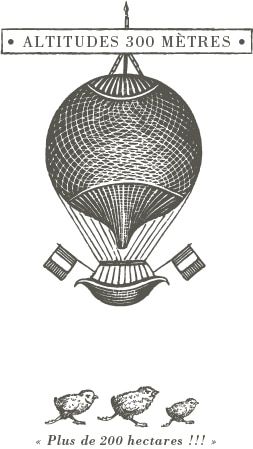
Set in the heart of a 200-hectare estate, Domaine Calmel & Joseph is notable for its exceptional geographical location, nestled between the foothills of the Val de Dagne, the Alaric and the Hautes Corbières.

At 240 – 300 metres above sea level, the farmed land is surrounded by many different trees (Aleppo pine, stone pine, beech, holm oak and white oak, ash, poplar, cypress, etc.) and Mediterranean scrub (juniper, Aspic lavender, broom, laurel, thyme, etc.). The diversity of exposure and soils – mainly sandy-clay limestone, with limestone outcrops on the hills – means that a variety of crops grow very well here.

The estate is a complex patchwork of geological and climatic influences, at the meeting point of the Corbières, Limoux and Malepère, Cabardès and Minervois appellation areas. The climate is typically Mediterranean, with the small Alaric mountain range blocking oceanic influences. Narbonne is only a few kilometres away, but temperatures are lower and rainfall much more abundant here.

« A REMARKABLE GEOGRAPHICAL POSITION »
The domaine in pictures

A commitment to innovative, organic and sustainable farming

Perfectly suited to innovation and sustainable farming

Thanks to its secluded location, Domaine Calmel & Joseph is the ideal place to experiment with innovative farming methods.

Results can be quickly obtained and analysed, and as wine merchants and winemakers, with single-vineyard selections spread across the Languedoc-Roussillon region, this data is very useful to us.

For several decades now, this dynamic region has been undergoing a revival. Many young, curious winegrowers are keen to put virtuous, environmentally-friendly farming methods into practice. Some of them are grower-partners with Calmel & Joseph, and the estate serves as a place for meeting and sharing.

Organic farming

Our key priority is bringing life to the very heart of the estate. Domaine Calmel & Joseph switched to organic farming across the estate, from the moment we became the owners. We do not use any chemical inputs – no pesticides, herbicides or fungicides. To combat disease, we work exclusively with very small doses of natural elements like sulphur and copper, and natural essences and decoctions.

We work to restore as much life as possible to the soil, by encouraging mycorrhizae and fauna such as earthworms, bacteria, fungi and insects. To do this, the soil is enriched by planting field beans, oats and barley during the winter months; their root systems help break through and aerate the clay layers and increase nitrogen levels.

Our soils are lightly tilled instead of deep ploughing, annual soil analyses guide our farming methods to ensure rich, living and balanced soils, and over the past few years, a significant increase in the diversity of flora and fauna has been observed.

« PUTTING LIFE AT THE HEART OF THE DOMAINE »

A wide variety of crops

Mixed farming is essential for maintaining natural balance and developing a rich, sustainable ecosystem.

We believe in living biodiversity.
In an organic vineyard, balance does simply happen on its own: rather, it is built day by day through observation, soil cultivation, and the careful farming of the vines. We maintain living soils rich in organic matter to encourage biological activity, naturally strengthen the vines’ resistance to pests and encourage their roots to grow deep down into the ground to draw up water and essential nutrients.

Plant diversity plays a major role in maintaining this balance, but it requires constant, careful attention and support. By working with nature, with rigour and humility, we preserve the vineyards’ long-term health and reveal the true expression of our terroir.

Vineyards: We farm 20 hectares of vines. The plots are small islands amidst the garrigue scrubland, surrounded by different species of trees that encourage the presence of wildlife such as bats, birds and insects. Our plots feature typically Mediterranean grape varieties such as Grenache Noir and Gris, Syrah, and Roussanne – and, more surprisingly for the Corbières appellation, there are also several hectares of Pinot Noir. This delicate grape variety is most commonly found in Burgundy, but it thrives at our estate, in the north-western of the Corbières appellation, where is benefits from highly favourable conditions.

Olive trees: Over 2,000 olive trees grow at Domaine Calmel & Joseph including Picholine, Lucques, Olivière, Bouteillan, Cayon and Clermont varieties, and we produce table olives (Lucques) as well as blended olive oil. Fruit fly attacks are treated naturally using tea tree essential oil.

Crops: Some 35 hectares of diverse crops are grown on the estate, without any chemical inputs: alfalfa, wheat, hay and various cereals are farmed, alternating from one year to the next.

Honey: The land at Domaine Calmel & Joseph has highly favourable conditions for beekeeping and honey production. This complex activity features many challenges (diseases and mortality, Asian hornets) and we are keen to maintain an environment where different species of bees can thrive and produce garrigue, lavender or thyme honey, so beekeepers are always welcome at the estate.

Lavender: A small plot of lavender is farmed at Domaine Calmel & Joseph to produce essential oil for soap making.

Almonds: Almond trees also feature at the estate, producing two varieties of table almonds, namely Ferraduel and its pollinator Ferragne.

Sheep and goats : In spring 2026 a flock of 20 sheep and 10 goats arrived at the estate. From March to November they graze in the garrigue scrubland and undergrowth, clearing the brush naturally and contributing to the fire prevention policy implemented on the estate. In the winter, from leaf fall until bud burst in the spring, they will graze in the vineyards, helping to control ground cover while naturally fertilising the plots.


« Nature is self-regulating and knows no partiality! »

  • 01 The origins
    of the Domaine
  • 02 A privileged
    position
  • 03 The Domaine
    in pictures
  • 04 An innovative
    domaine
  • 05 Agriculture
    biodiversity
  • 06 In the heart
    of nature
  • Legal Information
  • Facebook
Design by Agence-S
Gérer le consentement
Pour offrir les meilleures expériences, nous utilisons des technologies telles que les cookies pour stocker et/ou accéder aux informations des appareils. Le fait de consentir à ces technologies nous permettra de traiter des données telles que le comportement de navigation ou les ID uniques sur ce site. Le fait de ne pas consentir ou de retirer son consentement peut avoir un effet négatif sur certaines caractéristiques et fonctions.
Fonctionnel Always active
L’accès ou le stockage technique est strictement nécessaire dans la finalité d’intérêt légitime de permettre l’utilisation d’un service spécifique explicitement demandé par l’abonné ou l’utilisateur, ou dans le seul but d’effectuer la transmission d’une communication sur un réseau de communications électroniques.
Préférences
L’accès ou le stockage technique est nécessaire dans la finalité d’intérêt légitime de stocker des préférences qui ne sont pas demandées par l’abonné ou l’internaute.
Statistiques
Le stockage ou l’accès technique qui est utilisé exclusivement à des fins statistiques. Le stockage ou l’accès technique qui est utilisé exclusivement dans des finalités statistiques anonymes. En l’absence d’une assignation à comparaître, d’une conformité volontaire de la part de votre fournisseur d’accès à internet ou d’enregistrements supplémentaires provenant d’une tierce partie, les informations stockées ou extraites à cette seule fin ne peuvent généralement pas être utilisées pour vous identifier.
Marketing
L’accès ou le stockage technique est nécessaire pour créer des profils d’internautes afin d’envoyer des publicités, ou pour suivre l’utilisateur sur un site web ou sur plusieurs sites web ayant des finalités marketing similaires.
  • Manage options
  • Manage services
  • Manage {vendor_count} vendors
  • Read more about these purposes
Voir les préférences
  • {title}
  • {title}
  • {title}